LinkedIn Is Now the Backbone of AI Search Visibility 2026 Data
LinkedIn Is Now the Backbone of AI Search Visibility.
Here’s What That Means for You
If you work in professional services, executive leadership, consulting, speaking, or corporate communications, a quiet shift in B2B discovery has been happening right under our feet: your prospects, buyers, and members are no longer finding you through traditional search and direct referrals alone.
Instead, they are asking AI models to hand them one synthesized recommendation.
In this new environment, brand visibility isn’t just about search rankings, it’s about citation frequency. When someone asks an AI tool for an expert, a framework, or a provider, where does the model pull its answer from? Recent research shows that LinkedIn has unexpectedly emerged as one of the single largest data sources feeding those answers.
What the Research Reveals
Two independent studies, one from Meltwater analyzing 9.5 million AI citations, and another from Profound tracking 1.4 million citations, landed on remarkably similar conclusions within months of each other:
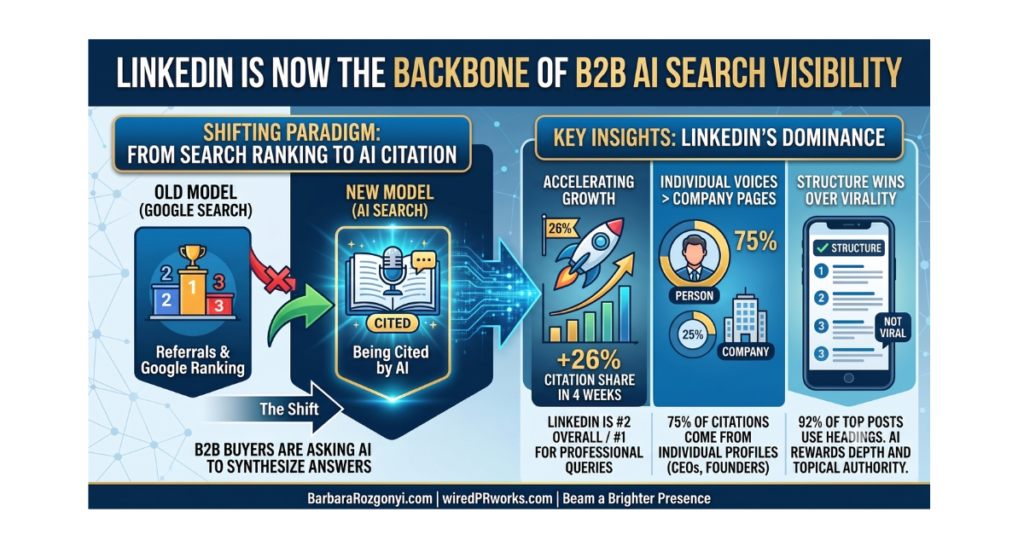
- Meltwater’s findings: Across six major AI models (including Copilot, Claude, Gemini, ChatGPT, and Google’s AI features), LinkedIn ranked as the #2 most-cited source overall, second only to YouTube. Its citation share grew 26% over a single four-week period.
- Profound’s findings: Between November 2025 and February 2026, LinkedIn’s domain rank on ChatGPT climbed from #11 to #5, more than doubling its citation frequency. Across all platforms Profound tracked, LinkedIn emerged as the #1 cited domain specifically for professional and B2B queries.
When a decision-maker asks an AI engine questions like “Who is a recognized keynote speaker on AI strategy?” or “How should a mid-market company structure a sales compensation plan?”, LinkedIn is now the primary domain AI relies on to answer.
4 Key Takeaways for Content Creators & Executives
1. Personal Profiles Beat Company Pages
Meltwater’s data shows that roughly 75% of LinkedIn citations come from individual member profiles, compared to just 25% from corporate Brand Pages. Content published by CEOs (8.2%) and founders (7.5%) saw the highest citation density. AI models prioritize attributed, personal expertise over broad institutional publishing.
2. Depth Trumps Engagement
According to Profound, the most-cited LinkedIn posts averaged only 15 to 25 reactions. Large language models don’t evaluate viral reach; they look for topical relevance, domain expertise, and clarity. You do not need thousands of likes to become an authoritative source for AI.
3. Clear Structure Is Essential
Articles and plain-text posts accounted for 83% of all cited content, and 92% of top-cited posts used clear subheadings, numbered steps, or list formats. Additionally, published long-form articles rose to nearly 35% of all LinkedIn citations, overtaking profile landing pages as the primary citation source. Structured content is significantly easier for AI models to extract and cite accurately.
4. Recency Matters
Nearly half (48%) of all cited content was published within the previous three months, while content older than a year made up just 12%. Because AI models favor current information, consistent publishing under your own name creates an ongoing compound effect for discoverability.
Executive Summary: What Drives AI Citations
| Strategy Area | Key Research Insight | Action Step |
| Publishing Voice | 75% of citations originate from individual profiles | Shift strategic thought leadership from company pages to named executive profiles. |
| Engagement Goal | Highly cited posts average only 15–25 reactions | Focus on clarity and deep subject-matter expertise rather than chasing viral engagement. |
| Formatting | 92% of top-cited posts feature clear headings or lists | Use clear subheads, numbered steps, and named frameworks in every article. |
| Publishing Frequency | 48% of cited posts were published in the last 90 days | Maintain a regular posting cadence (2–3 short posts weekly, 1–2 longer articles monthly). |
Practical Steps to Build Your AI Search Presence
- Claim your expertise in plain text. Publish insights under your individual profile rather than relying solely on corporate accounts or third-party links.
- Structure every post for readability. Break key ideas down with clear headers, bullet points, and defined steps so both human readers and AI crawlers can digest them instantly.
- Keep your content fresh. A steady publishing rhythm ensures your profile remains active within the recency windows AI engines prioritize.
Sources
- Meltwater, “How LinkedIn Content Wins in AI Search” — full report (9.5M citations analyzed)
- Profound, “LinkedIn is the Most-Cited Domain for Professional Queries in AI Search” — full analysis (1.4M citations analyzed)
About the Author
Barbara Rozgonyi is the founder of CoryWest Media and publisher of WIRED PR Works, where she advises executives, speakers, and brand builders on growing visibility across an evolving AI search landscape. A keynote speaker, podcast host, and fractional CMO, Barbara has published over 1,500 articles on personal branding, digital PR, content strategy, and AI optimization. Connect with Barbara on LinkedIn or subscribe to her Brighter Presence newsletter for insights on remaining visible and trustworthy in the digital era.
Post updated on July 31, 2026.

 English
One Comment