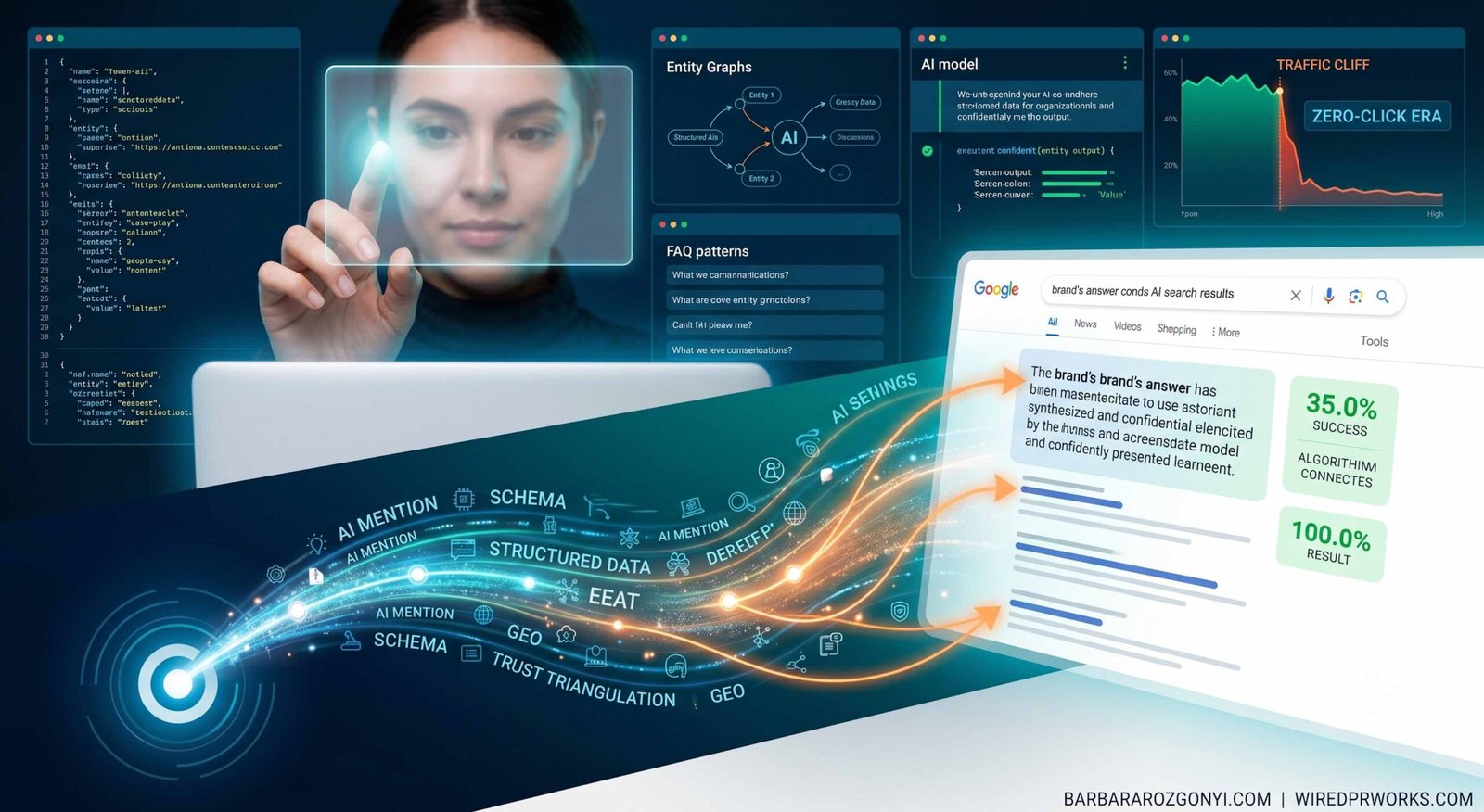
Be the Answer, Not a Footnote: How to Navigate the 2026 Generative Engine Disruption
The business model of the open web is fundamentally shifting. As artificial intelligence transforms how information is synthesized, search engines have evolved from mere gateways into final destinations. For public relations professionals, fractional CMOs, and enterprise leaders, the traditional playbook of optimizing solely for web traffic and link clicks is rapidly breaking.
This recap of the May 2026 EMARKETER Studio report, The Publisher Reckoning: How AI Search Is Breaking the Internet’s Business Model, outlines the reality of the “traffic cliff” and provides a strategic framework to maintain brand authority in a zero-click reality.
The Data: The Scope of the Zero-Click Reality
- The Click Collapse: Data shows that when users encounter an AI summary, they click a traditional search link just 8% of the time, compared to 15% on pages without summaries.
- Default Behavior: Propelled by Google AI Overviews, zero-click searches grew to a 68% share of queries by mid-2025. Bain & Company research indicates that number has climbed to 60% of all searches ending without a single click.
- Session-Ending Trends: 26% of users encountering an AI summary end their browsing session entirely, nearly doubling the 16% session-termination rate seen in traditional search layouts.
- The Publisher Impact: Organic traffic to major news sites fell dramatically , forcing prominent newsrooms into severe layoffs and prompting legal action from major publishers over content scraping and revenue diversion.
Key Takeaways Optimized for Modern Visibility
To remain competitive, your digital strategy must evolve across five primary pillars: AI, SEO, GEO, EEAT, and WIIFM.
1. AI Optimization: Shifting from Clicks to Mentions
- The Strategy: In an ecosystem where answers are generated on the fly, a brand’s appearance rate within LLMs (like ChatGPT, Gemini, and Perplexity) is the new metric for success.
- Actionable Tactic: Move measurement models away from pure web sessions and page views. Implement AI visibility tracking to monitor how frequently and accurately your brand is cited as the definitive answer for target enterprise queries.
2. SEO Transformation: Optimizing for LLM Retrieval
- The Strategy: Technical SEO is no longer just about keyword matching for algorithms; it is about building clean data structures that large language models can frictionlessly parse and retrieve.
- Actionable Tactic: Heavily prioritize deeply structured data, schema markup, robust FAQ hubs, and direct, conversational answers to complex buyer questions. Your website must function as an undisputed source of clean, primary data.
3. GEO (Generative Engine Optimization): Playing the Whole Field
- The Strategy: 54% of marketers plan to execute a GEO strategy in 2026 fully, yet a significant portion of the market remains frozen in traditional frameworks. GEO requires optimization across paid, organic, owned, and earned media simultaneously to feed the models.
- Actionable Tactic: Brand content requires active distribution, not just passive publication. Repurpose core insights onto high-authority platforms that LLMs heavily crawl, ensuring your enterprise is conversational, highly visible, and contextualized across multiple formats.
4. EEAT (Experience, Expertise, Authoritativeness, Trustworthiness): Triangulating Authority
- The Strategy: AI search models do not rely on your website alone; they triangulate across the broader web to verify claims. If your brand is the only entity talking about your expertise, algorithms classify it as self-promotional rhetoric.
- Actionable Tactic: Build off-site validation through third-party rankings, executive podcast features, verified community threads, and objective expert commentary. When multiple credible online voices agree on your authority, AI models confidently surface your business as the recommended solution.
5. WIIFM (What’s In It For Me) for Enterprise Ideal Client Profiles (ICPs)
- The Strategy: Eight out of ten B2B software and technology buyers actively use generative AI to research vendors and short-list providers. When a prospective buyer asks an LLM for the premier partner in your space, your presence in that answer is the ultimate value-add.
- Actionable Tactic: Align your content strategy directly with deep-funnel enterprise pain points. Ensure your digital footprint clearly details how you solve client challenges, allowing AI models to accurately synthesize your value proposition to high-intent executives.
Frequently Asked Questions (FAQ)
Q: If organic click-through rates are dropping, should we stop investing in our corporate blog and content marketing? A: Absolutely not. However, the purpose of your blog must pivot. Instead of writing thin content designed to trap keyword clicks, your blog should host deeply researched, high-intent primary material, comprehensive FAQs, and explicit technical schemas. Your owned channels are no longer just a destination for human readers; they are the audition ground for AI model citations.
Q: How do AI models evaluate a brand’s authority if they aren’t clicking through to the website? A: Models look for consensus. They synthesize data from your structured owned content alongside external footprints: earned PR media, independent industry reviews, subject-matter expert discussions, and community forums. True authority is established when your owned claims are validated across the broader digital ecosystem.
Q: What is the risk of delaying a Generative Engine Optimization (GEO) strategy? A: The window for early-mover advantage is brief. While enterprise legacy competitors delay action due to prolonged internal reviews, nimble brands can optimize their digital footprints to capture AI mindshare immediately. Once a dominant industry player establishes deep algorithmic authority and citation baseline value within the models, displacing them becomes substantially more capital-intensive.
About Barbara Rozgonyi
Barbara Rozgonyi is a leading fractional CMO, international keynote speaker, and the founder of CoryWest Media™. As an expert AI and PR visibility strategist, she is the creator of the proprietary AURAS Framework™ and the WIRED 5D PR framework. Since 2006, Barbara has published WiredPRWorks™, a premier digital platform recognized globally for its forward-looking insights into public relations, digital marketing, and executive visibility. She guides B2B enterprises and thought leaders to navigate shifting search paradigms, build trusted online authority, and transform their digital presence to successfully “be the answer” in an AI-driven economy. Get in touch for speaking, audits, training, or influencer projects.
AI was a collaborative creator in the content and image.

 English