How Do Small Businesses Actually Use AI Right Now? 6 Practical Lessons from Charlotte
Most small and mid-size businesses are already experimenting with AI. The real difference comes down to whether they are using it to save hours and improve results or simply creating more clutter and more work.
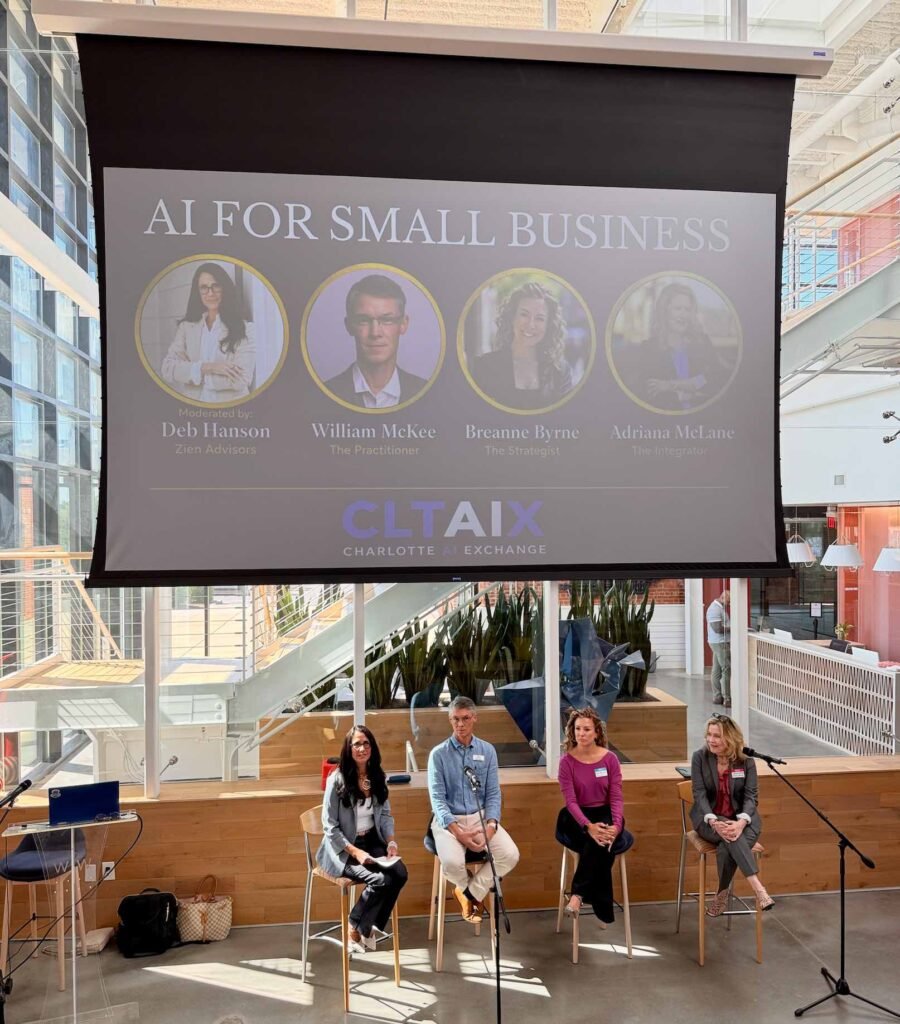
On July 31, the Charlotte Marketing AI Exchange (co-founded by Jessica Hreha and Tammy Tufty) hosted “Work Smarter with AI,” a panel at Wray Ward where local business leaders shared how they’re using AI to save time, improve workflows, and grow their businesses. Moderated by Deb Hanson of Zien Advisors, the conversation skipped the hype and theory in favor of a practical look at what’s actually working, what’s not, and where to start.
Three panelists shared their perspective on what’s working on the front lines:
- William McKee, Managing Partner at Knowmad Digital Marketing (the agency practitioner).
- Breanne Byrne, CMO at Syntari International (the strategist).
- Adriana McLane, Founder of Fulfilling Strategy (the integrator).
Here’s what came out of it: where AI is saving the most time, the tools they use every week, lessons learned from real implementation, and practical ideas you can apply right away.
1. Automated Meeting Notes Buy Back Hours and Protect Relationships
One practitioner runs AI note-taking on almost every client call. Transcripts drop into the right folder, action items get pulled, and a clean summary is ready for human review before anything goes out.
The bigger win isn’t the summary itself. It’s that the team can stay fully present instead of half-listening while typing. Commitments made in the moment get captured instead of forgotten three days later. If your calendar is packed with meetings, this single workflow is usually the fastest way to reclaim hours and look more reliable to clients.
2. Start With One Repetitive Task (And Give It a Week)
The panel’s advice was unanimous for both teams and solopreneurs: look at your weekly calendar and pick the single task you repeat most often. Build a simple framework inside Claude or ChatGPT and test it for seven days. Proposals, status updates, client replies, and slide decks are all ideal candidates.
If a workflow fails to save time after a week, drop it and move on. There’s no reason to stay loyal to an inefficient process.
The strategists also emphasized team training. Most employees are already using free AI tools behind the scenes. A little guidance on prompting, brand voice, and system connectors keeps those drafts from turning into generic “work slop” that requires heavy rewriting.
3. Purpose-Built Applications Beat Generic Chat
Fast ROI happens when companies stop telling employees to “just use ChatGPT” and instead adopt tools built for specific jobs. Examples include sales order automation that drops email or voice requests straight into an ERP system, or AI features embedded inside an existing CRM.
While generic chat can be helpful, it often produces mixed results. Mapping the actual business process first and selecting a purpose-built tool second is where the true return on investment shows up.
4. Software Licenses Do Not Equal Adoption
A common mistake among mid-market companies is assuming that purchasing enterprise AI licenses means digital transformation is complete.
Buying licenses is the easy part. The harder, ongoing work involves continuous training, clear internal tool ownership, and shifting workplace culture so employees treat AI as a daily assistant rather than a novelty they try once and forget.
5. Expensive Mistakes Are Usually Cultural, Not Technical
One agency owner shared a candid story about spending $18,000 on an AI-powered SEO platform that sat completely unused after three months because the team never bought into it.
Panelists noted the same pattern with Microsoft Copilot rollouts that skip training. Weak prompts produce poor answers, and users burn through usage credits by keeping the same endless chat thread open instead of starting fresh.
The fix is cultural. Monthly lunch-and-learns, clear tool owners, and involving staff in the evaluation process early prevent expensive shelfware.
6. AI Cannot Replace Relationship Context
Even a deeply integrated AI system doesn’t know the subtle details that build long-term business trust. It doesn’t know that a specific client prefers not to receive calls before 10 a.m., it doesn’t remember a long-standing family discount, and it cannot offer genuine empathy when a conversation gets difficult.
AI excels at back-office efficiency, but human trust remains the core foundation of your value proposition.
Building a Multi-Model Tool Stack
No one on the panel recommended relying on a single AI platform. Different models excel at different jobs:
| LLM Engine | Primary Strength | Recommended Business Role |
| Claude | Writing, custom skills, workspace connections | Internal assistant tied to CRM or Slack |
| Perplexity | Real-time web research with sources | External research consultant |
| ChatGPT / Gemini | Image generation and visual tasks | Creative support and visual workflows |
| NotebookLM | Document analysis and synthesis | Competitive research and knowledge engine |
One panelist shared a favorite strategy: treat models as sparring partners. Build a plan in one tool, paste it into another without revealing where it came from, and ask the second model to find logical flaws. Comparing outputs helps you catch weak spots before launching.
Why LinkedIn Is Now the Backbone of AI Search Visibility
Here’s the part that connects the operational lessons to growth. Search is shifting, and LinkedIn keeps surfacing as the quiet infrastructure layer for professional visibility. Two independent 2026 studies show LinkedIn has emerged as one of the largest data sources feeding AI-generated answers to professional and B2B queries.
I broke the full data down in my deep-dive analysis here on WIRED PR WORKS, LinkedIn Is Now the Backbone of AI Search Visibility 2026 Data.
Meltwater’s analysis of 9.5 million AI citations found LinkedIn ranks as the #2 most-cited source overall across six major AI models, second only to YouTube, with its citation share growing 26% in a single four-week period. Profound’s separate tracking of 1.4 million citations found LinkedIn’s domain rank on ChatGPT climbed from #11 to #5 between November 2025 and February 2026, and across all platforms tracked, LinkedIn emerged as the #1 cited domain specifically for professional and B2B queries.
Here’s what the research reveals for executive visibility:
- Personal Profiles Beat Company Pages: Roughly 75% of LinkedIn citations originate from individual member profiles, compared to just 25% from corporate Brand Pages. AI models prioritize personal, attributed expertise over institutional publishing.
- Depth Outperforms Virality: Top-cited posts average only 15 to 25 reactions. Large language models evaluate topical relevance, clarity, and domain depth — not viral likes.
- Structure Is Essential: Long-form articles now account for nearly 35% of all LinkedIn citations, overtaking profile pages as the primary citation source, and top-cited posts consistently use clear subheadings, numbered steps, or list formats.
- Recency Rules: A meaningful share of cited content was published within the last 90 days, reinforcing that AI models favor current information over older posts.
Maintaining an active, well-structured presence on LinkedIn is no longer just a networking play; it is foundational infrastructure for how your brand gets recommended in AI answers.
Frequently Asked Questions
Thanks to the panel for answering these questions.
How do you protect client privacy with AI note-takers?
Check your software settings. Paid team and enterprise plans usually allow you to turn off data training options. For sensitive meetings, inform participants that an AI note-taker is present, explain how the transcript will be used, and keep files in secure cloud storage.
Do you have to tell clients you used AI on a project?
For standard business writing, research, and ideation, disclosure is generally not required unless you operate in a regulated industry. Clients care about accuracy, quality, and results. Your job is to apply judgment and human oversight so the final work is solid.
How do you get non-technical teams on board?
Bring employees into the tool evaluation process early. Frame AI as a assistant that handles tedious admin tasks so staff can spend time on higher-value work. Establishing an informal AI council or hosting relaxed monthly share sessions lowers anxiety far more effectively than top-down mandates.
What tools work best for transcribing in-person meetings?
Mobile apps like Otter, Fireflies, or Google Recorder handle offline conversations well. Dedicated hardware devices like Plaud are another reliable option. Once you have the transcript, export it into your primary AI workspace to generate summaries and action steps.
A Simple 72-Hour Action Plan
At the close of the program, the panel suggested choosing one step to complete over the next three days:
- Fix One Bottleneck: Identify your most repetitive weekly task and build a basic AI workflow for it.
- Build a Fact-Checker: Create a prompt or custom skill that forces your AI model to verify sources and score its confidence (remember, unguided models still hallucinate up to 30% of the time!).
- Clean Up Your LinkedIn Profile: Format a recent post or your profile summary using clear headings and bullet points so AI search engines recognize your topical authority.
- Audit Competitors: Upload public decks or website copy from three competitors into Google NotebookLM and ask the tool to surface messaging gaps.
About Barbara Rozgonyi
Barbara Rozgonyi has guided organizations through shifts in search, social media, PR, and marketing for more than 25 years. As founder of CoryWest Media and publisher of WIRED PR WORKS, she’s shaped visibility strategies for Fortune 100 brands, associations, agencies, entrepreneurs, and even an entire village of small businesses.
A future-focused marketing and PR strategist, fractional CMO, and international keynote speaker, Barbara shows organizations how to integrate AI without losing the human trust that makes people choose them. Because AI may change how businesses get discovered, but being worth discovering is still the point.
Ready to build a Brighter Presence™ in the AI era? Visit BarbaraRozgonyi.com.


 English