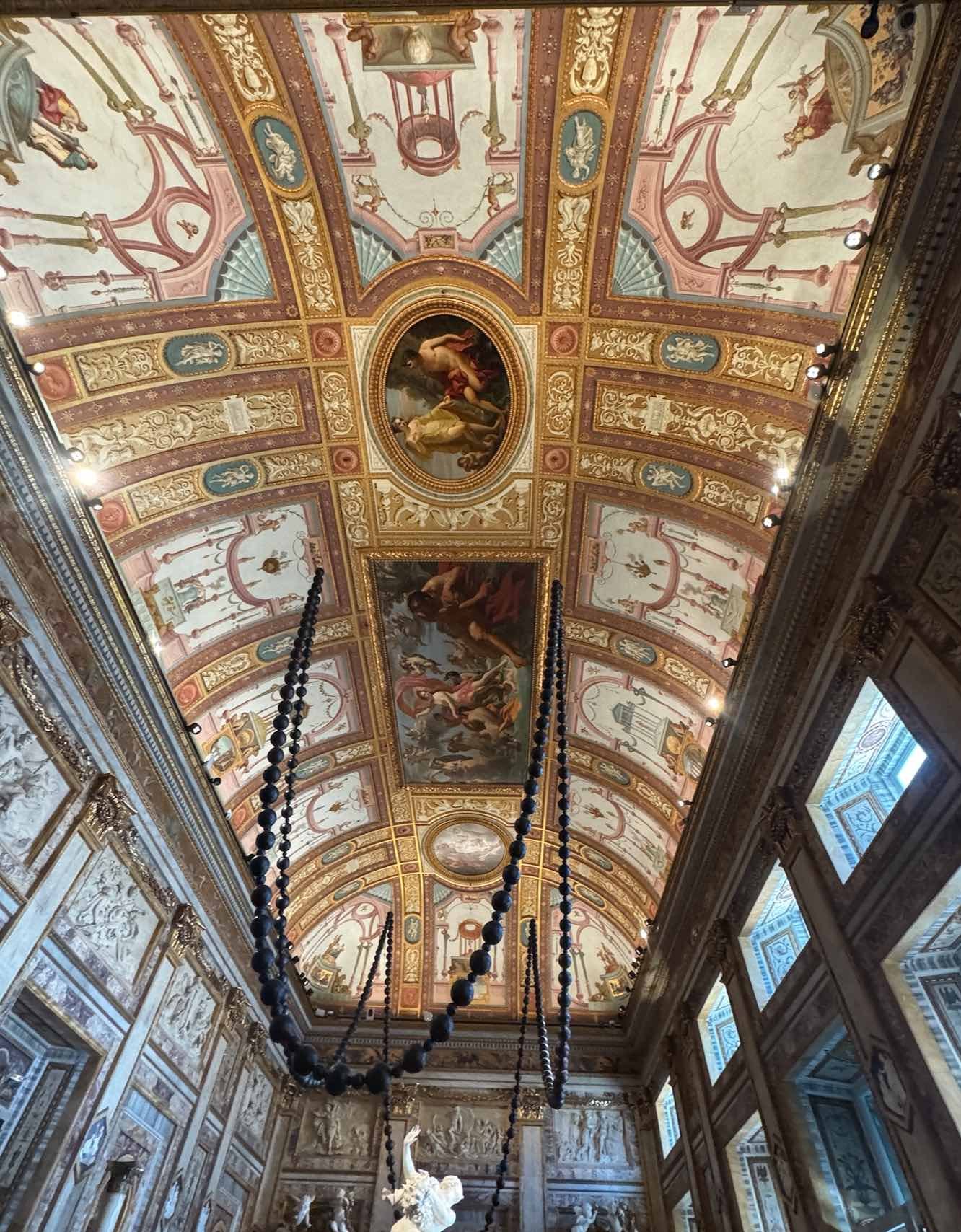
Two Hours at Galleria Borghese: What Rome’s Most Curated Museum Reveals About Focus, Visibility, and the Power of Attention
Travel Tuesday edition, September 2025
In an age where AI systems index, interpret, and prioritize the content we create, the places that teach us the most about visibility aren’t always digital. Sometimes they’re carved in marble. During our September 2025 visit to Rome’s Galleria Borghese, the combination of a strict two-hour window, masterful works by Bernini and Caravaggio, and a groundbreaking exhibition by Wangechi Mutu revealed a truth that applies just as much to modern communication as it does to art history: focus—not volume—is what creates impact. This Travel Tuesday reflection on wiredPRworks explores how curated space sharpens attention, strengthens message clarity, and elevates presence, both in museums and in our AI-shaped world.
When you walk into the Galleria Borghese in Rome, time behaves strangely. It expands. Contracts. Focuses. You quickly realize this museum wasn’t designed for wandering or attempting to “see it all.” It was designed for something far more powerful: intention.
Every visitor is allowed inside for exactly two hours. Not a minute more. Not a minute less.
Reservations are required. Entry is capped.
And the result is a rare luxury in modern travel: space.
Space to look. Space to think. Space to feel.
During our September 2025 trip to Italy, this simple constraint transformed the experience and revealed a visibility lesson I didn’t expect.
A Guided Tour Into the Details: Bernini, Imperfections, and the Humanity of Genius
We booked a guided tour, and our guide was masterful. She didn’t simply explain where we were; she showed us how to see.
At Bernini’s extraordinary Apollo and Daphne, a sculpture Rick Steves has called his favorite in Europe, she pointed out small deviations and imperfections a casual eye might never notice. A shift in proportion. A line that interrupts the flow. Places where Bernini pushed marble past its natural limits.
These weren’t flaws. They were fingerprints of humanity.
The mistakes didn’t diminish the masterpiece.
They made it more alive.
In a world where technology leans toward polished perfection, this reminder felt grounding. Great work, artistic or strategic, is rarely flawless. It carries energy, movement, tension, risks, and choices.
The Borghese makes room for all of that.
Caravaggio’s Shadows: A Lesson in Contrast and Presence
Our timing was fortunate. September 2025 included a special Caravaggio spotlight exploring his mastery of chiaroscuro. Each room invited visitors deeper into the interplay of shadow and light—not as decoration, but as narrative force.
Caravaggio understood that visibility is not about brightness. It is about contrast.
Light only becomes meaningful when darkness is present.
A message only becomes clear when noise is removed.
A leader’s presence only resonates when intention shapes it.
Standing inches from his canvases—unrushed, unpushed, unjostled—reinforced the idea that what you choose not to illuminate can be just as important as what you highlight.
A Contemporary Counterpoint: Wangechi Mutu’s “Black Soil Poems” (June 10–September 14, 2025)
During our visit, the Borghese also hosted a major contemporary exhibition: Wangechi Mutu: Black Soil Poems, the first solo show by a living woman artist inside the historic Villa Borghese.
Mutu’s Kenyan-American voice brought a striking tension to the space. Her site-specific sculptures and installations conversed with Bernini’s dynamism and Caravaggio’s drama while inviting visitors to question longstanding narratives about who is represented, who is remembered, and who is allowed to take up space in cultural institutions.
Her work reframed the gallery not as a static monument to European art history, but as a living conversation between past and present. The exhibit added depth, challenge, and a broader lens—urging visitors to consider visibility not just as a personal tool, but as a societal one.
The Borghese Method: Curated Space Creates Lasting Impact
Compared to sprawling museums that overwhelm the senses, the Borghese’s design is intentional:
- Limited guests
- Two-hour windows
- Focused collections
- Guided insight
- Architectural storytelling
The museum becomes an exercise in designed attention.
And this is where the visibility connection emerges:
**Being seen isn’t about showing more.
It’s about showing what matters with clarity, structure, and focus.**
Brands, leaders, and creators can take a cue from this model:
- Boundaries strengthen your message.
- Clarity outperforms volume.
- Curation amplifies authority.
- Depth creates emotional memory.
- Imperfection humanizes trust.
The Borghese doesn’t try to be everything.
It chooses precisely what to highlight—and elevates it.
Why Travel Tuesday Stories Belong on a PR and Visibility Blog
People sometimes ask why a digital PR strategist, AI communicator, and Visibility Architect writes about travel nearly every Tuesday.
The answer is simple: travel sharpens the skills that shape great communication.
Travel teaches you how to observe what others miss.
Art teaches you how to interpret what you see.
Photography teaches you how to frame what matters.
Culture teaches you how to understand context.
And curated experiences like the Borghese teach you how focus amplifies impact.
Travel Tuesday isn’t a departure from visibility work. It feeds it.
It reminds me—and my readers—that clarity, wonder, and perspective are essential ingredients in every storytelling, branding, and communication challenge we face today.
FAQ: Planning Your Visit to Galleria Borghese (2025 Edition)
How long is a visit to Galleria Borghese?
Exactly two hours. Entry times are strictly enforced.
Are reservations required?
Yes. Timed-entry reservations are mandatory and often sell out.
Is a guided tour worth it?
Absolutely. Guides offer insights into technique, context, and even subtle imperfections that deepen appreciation.
What should you not miss?
- Bernini’s Apollo and Daphne
- Bernini’s David
- Caravaggio works such as Boy with a Basket of Fruit
- Contemporary exhibitions (like Wangechi Mutu in 2025)
What was the special exhibition in September 2025?
Wangechi Mutu’s Black Soil Poems, the first solo show by a living woman at the Borghese.
How does the Borghese compare to the Vatican Museums?
It’s more intimate, more focused, and far less overwhelming. Many visitors consider it a more emotionally resonant experience.
Is photography allowed?
Yes, non-flash photography is generally permitted.
Final Reflection: When Space Is Limited, Meaning Expands
The Borghese is a lesson in curation, boundaries, and intentional design.
It shows us that visibility isn’t a race for attention—it’s a strategy for clarity.
Limit the noise.
Honor the details.
Create the contrast.
And let the masterpiece emerge.
That applies to art.
It applies to leadership.
And it applies to every message we send into the world.
About Barbara Rozgonyi
Barbara Rozgonyi is The Visibility Architect, a Top 100 Global Speaker and founder of Wired PR Works and CoryWest Media.
A leading voice in AI-powered communication, digital PR strategy, and executive visibility, she guides organizations, associations, and thought leaders to build trust, authority, and meaningful influence in an accelerating world.
Her proprietary WIRED 5D PR Framework and Visibility Architecture System help brands and executives turn clarity into connection and presence into performance. Barbara’s work as a writer/speaker has been featured in Entrepreneur Press, Crain’s Chicago Business, Ragan, and at major events including PRSA, IABC, AMA, and DigiMarCon.
Travel, photography, and cultural storytelling inform her approach to visibility—offering a richer, more human lens on leadership and communication in the AI era.
In a world where AI filters, ranks, and amplifies our presence long before a human ever arrives on the page, the lesson from the Borghese feels more relevant than ever: curation is clarity. What we choose to highlight—and what we choose to let go of—shapes how others experience our work. The two-hour window, the interplay of shadow and light, the conversation between classical and contemporary voices—all of it reminds us that visibility isn’t about being everywhere. It’s about being unmistakable where it matters. When we give our work the same intentional framing that the Borghese gives its masterpieces, we create the conditions for deeper connection and lasting resonance.
 English